- Hadrian raised $1.37 billion at $7.87 billion valuation, five times its 2023 value
- Company expanded to 3 million square feet across four sites in one year
- Funds will support expansion into munitions, shipbuilding, and autonomous systems production
- JPMorgan Chase Strategic Investment Group anchored the Series D round
Hadrian closed a $1.37 billion Series D at a $7.87 billion valuation, marking one of the largest private financing rounds a defense supplier has ever completed. The company has grown its manufacturing footprint to just under 3 million square feet across four sites, adding new factories in Mesa, Arizona, and Muscle Shoals, Alabama. JPMorgan Chase & Co.’s Strategic Investment Group anchored the $1.37 billion Series D round, with participation from 1789 Capital, Morgan Stanley Wealth Management, funds managed by Apollo, accounts advised by T. Rowe Price Associates, Inc., CapitalG, Andreessen Horowitz, Founders Fund, Lux Capital, Altimeter, Construct Capital, and existing investors.
Factory expansion targets complete systems, not just parts
In March, the U.S. Navy said the company would mass-produce components in Alabama for the service’s Virginia-class attack and Columbia-class ballistic missile submarines. The company is pushing beyond precision parts manufacturing into delivering full systems for munitions, shipbuilding, and autonomous systems programs. It plans on using its new funds to establish new factories, build out research and development, add new production capabilities, and hire over 1,000 new engineers and operators at the company.
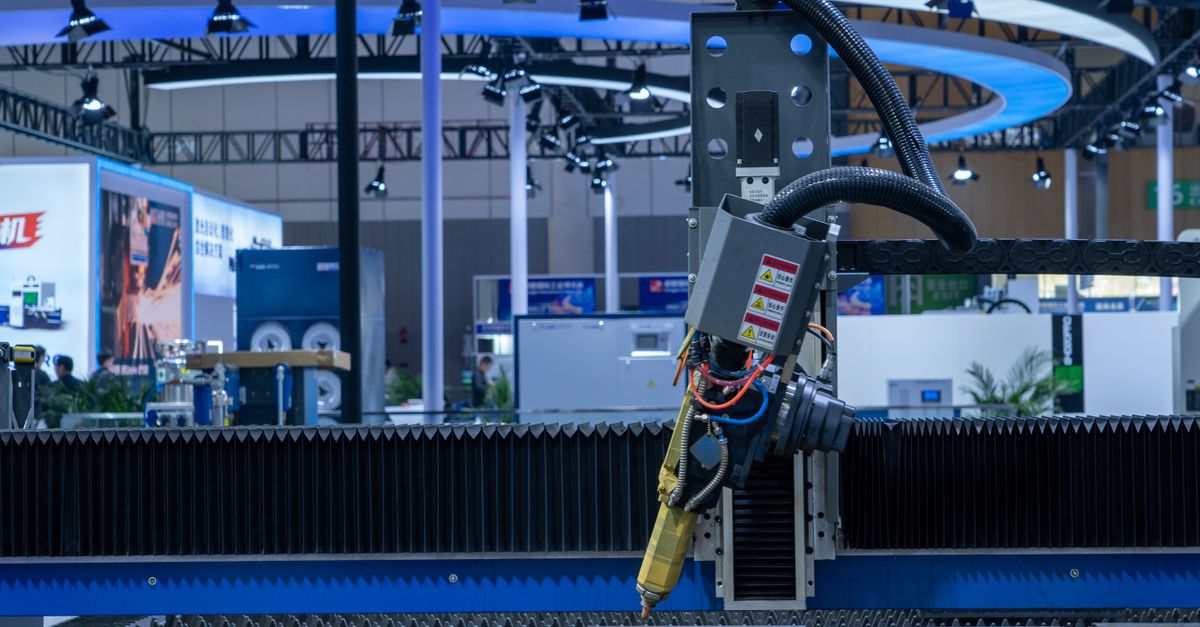
Hadrian works with the world’s largest arms makers, including Lockheed Martin and RTX, as well as neo-primes and smaller outfits, like Anduril Industries. The “Factories-as-a-Service” model pairs proprietary Opus software with robotics and technicians inside highly automated facilities, letting defense contractors scale production without building their own plants.
Manufacturing capacity is the defense industry’s real bottleneck
Manufacturing capacity, rather than funding, is now the primary limiting factor in defense acquisition speed, impacting contractors and suppliers across the defense industrial base. Workforce availability is emerging as a dominant constraint on defense production capacity. The industrial base relies heavily on skilled manufacturing roles such as machinists, welders, technicians, and toolmakers. “There aren’t enough skilled tradespeople to even be hired,” Power said. “We need millions and millions and millions.”
The bottleneck isn’t theoretical. Solid rocket motors are critical for munitions like the Guided Multiple Launch Rocket System and the Standard Missile family. The supplier base has consolidated, lead times are long, and energetics capacity is constrained. Even when prime contractors sign orders and expand final assembly, output falls short when tier-2 and tier-3 suppliers hit capacity limits.
Valuation jump reflects repriced investor appetite
The raise takes Hadrian’s disclosed funding to roughly $1.73 billion, against $359.5 million before this round. That the company more than quadrupled its lifetime capital in a single financing, at close to eight billion in value, is a fair measure of how quickly investor appetite for defense manufacturing has repriced. The timing aligns with federal budget shifts: The budget includes an additional $1.3 billion for industrial-based supply chain improvements and an additional $2.5 billion for missiles and munitions production expansion. The budget also includes significant new investments of $200 million for automation and artificial intelligence (AI).
The valuation also assumes execution risk. A near-$8 billion private company valuation presumes those factories fill with production contracts and that Hadrian can deliver complete weapons systems at scale, not just components. That’s a step-function harder than running precision machining operations—it means qualifying processes, managing program timelines, and hitting delivery milestones that prime contractors depend on. The capital is there; now the company has to build systems that work in the field, repeatedly, on schedule.
Hadrian’s round shows investor capital is no longer the constraint in defense manufacturing—it’s factory throughput and skilled labor. Automated systems still need technicians who can troubleshoot, and if Hadrian needs millions of skilled workers across a $7.87 billion valuation, your operation likely faces the same ratio. Budget for both the machines and the people who keep them running, or the automation investment won’t translate to output.
What is Hadrian’s Factories-as-a-Service model?
Hadrian builds and operates highly automated manufacturing facilities that defense and aerospace companies use to produce components and complete systems without building their own plants. The company combines its Opus software platform with robotics and skilled technicians to run production at scale, allowing customers to increase output rapidly without capital-intensive factory construction.
Why is manufacturing capacity limiting defense production more than funding?
The Department of Defense has approved substantial budget increases for munitions, shipbuilding, and other programs, but production output is constrained by physical factory capacity and workforce availability. Skilled tradespeople like machinists, welders, and technicians are in short supply, and expanding manufacturing infrastructure takes years. Even when prime contractors have funding and signed contracts, bottlenecks at tier-2 and tier-3 suppliers prevent faster delivery.
Article Source: Hadrian Raises $1.37B Series D, Valuing Automated Defense Manufacturer at $7.87B