- Generalist hit $2 billion valuation using human demonstrations captured with handheld grippers and GoPro cameras.
- Company amassed 500,000+ hours of real-world data from contributors globally.
- UMI research from Toyota, Columbia, Stanford enables hardware-agnostic policies across robot platforms.
- One-degree-of-freedom gripper design prioritizes simplicity and robustness over complexity.
Generalist has amassed a dataset exceeding 500,000 hours of real-world robotic activity by distributing hand-mimicking grippers to contributors worldwide. The approach builds on Universal Manipulation Interface (UMI) research that uses puppet-like end effectors and GoPro cameras to capture human tasks such as washing dishes and picking up objects, converting those demonstrations into training data for robot foundation models.
The company was founded by Pete Florence, a former DeepMind senior scientist who helped create RT-2, a robotic control system for vision-language-action models. Generalist raised $400 million in new funding, bringing the company’s valuation to $2 billion, with Radical Ventures leading the round.
Simple grippers solve the data collection problem
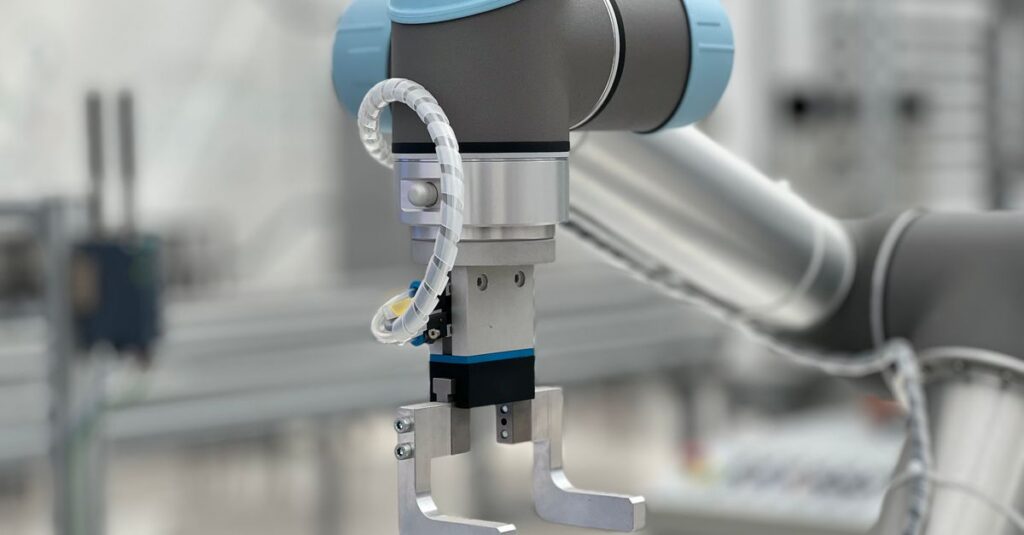
UMI employs hand-held grippers coupled with careful interface design to enable portable, low-cost, and information-rich data collection, with the hardware taking the form of a hand-held parallel jaw gripper mounted with a GoPro camera. Samantha Castellanos, Generalist’s founding mechanical engineer, emphasized the company’s focus on a one-degree-of-freedom gripper design. The simplicity contrasts with competitors pursuing more complex end effectors, but Castellanos argues simple things are often the most robust—a core hardware value when production lines can’t afford downtime every five minutes.
The resulting learned policies are hardware-agnostic and deployable across multiple robot platforms. At Automate in June, Generalist demonstrated this flexibility by folding cardboard boxes with Universal Robots arms on one side of the hall while repairing robot vacuums with Flexiv arms across the McCormick Center. The models showed intelligence to recover in real time when things went wrong, shifting how attendees thought about automation reliability.
Foundation models face a data scarcity no internet can solve
“There’s no internet of robotic data the way there’s an internet for LLM data,” noted Radical Ventures partner Rob Toews. One challenge facing the company — and the robotics industry broadly — is the scarcity of training data. While language models trained on humanity’s printed history, robot foundation models need physical-world interaction data that doesn’t exist in digital archives.
The data bottleneck creates an opening for companies willing to generate their own datasets at scale. Competitors like Rhoda AI, which raised $450 million at a $1.7 billion valuation in March, have turned to publicly available videos online. Human Archive, a Y Combinator Winter 2026 startup, is mounting head-cams on gig economy workers to collect first-person-point-of-view videos to train robots. Each approach attempts to solve the same fundamental constraint: robots need embodied experience data that simply doesn’t exist at internet scale.
Hardware simplicity drives model performance
Castellanos framed Generalist’s strategy as model-first: “Our main goal is to make the best model in the world. Everything we do is to make the model better.” That includes data collection methods, tool variety, and different types of world interaction. The company operates in a crowded space that has raised more than $4 billion cumulatively, including standouts like Skild AI ($2 billion), Physical Intelligence ($1 billion), Field AI ($300 million), and RLWRLD ($41 million).
The gripper’s one-degree-of-freedom design reflects a tactical choice: robustness beats capability on paper. In industrial settings, a gripper that works reliably under production conditions outperforms a dexterous hand that requires constant maintenance or fails under variable loads. Generalist plans to use the new capital to develop its next generation of models, expand its data collection infrastructure, and grow its computing resources. The focus remains on feeding better data into better models rather than engineering increasingly complex hardware that might look impressive in demonstrations but fail in deployment.
This creates a strategic bet that differs from humanoid-focused competitors. While companies like Genesis pursue wheeled platforms and others chase anthropomorphic designs, Generalist is betting that the intelligence layer—trained on massive human demonstration data—matters more than the physical form factor. The approach mirrors how Path Robotics uses vision guidance for welding: the AI model does the heavy lifting, not mechanical complexity.
Generalist’s 500,000-hour dataset represents a genuine industrial advantage in a market where data scarcity is the binding constraint. The one-DoF gripper strategy is defensible for plants prioritizing uptime over dexterity, but the real test comes when competitors using video scraping or synthetic data reach comparable scale at lower collection cost. Watch whether Generalist’s human-demonstration approach maintains quality advantages as others scale alternative methods, and whether simple grippers prove robust enough for contact-rich tasks that demand precision force control.
How does UMI differ from traditional robot teleoperation for data collection?
UMI uses portable handheld grippers with GoPro cameras that humans operate in any environment, rather than expensive lab-based teleoperation rigs tied to specific robot hardware. The demonstrations transfer directly to multiple robot platforms because the learned policies are hardware-agnostic, eliminating the need to recollect data for each new robot system.
Why does Generalist use a one-degree-of-freedom gripper instead of more complex hands?
Simple parallel-jaw grippers with single DoF are more reliable in production environments where downtime costs money. Complex multi-fingered hands offer greater dexterity in demonstrations but require more maintenance and fail more frequently under real-world conditions. Generalist prioritizes robustness and uptime over mechanical complexity, betting that model intelligence compensates for simpler hardware.
Article Source: How Generalist uses human demonstration data for robot learning