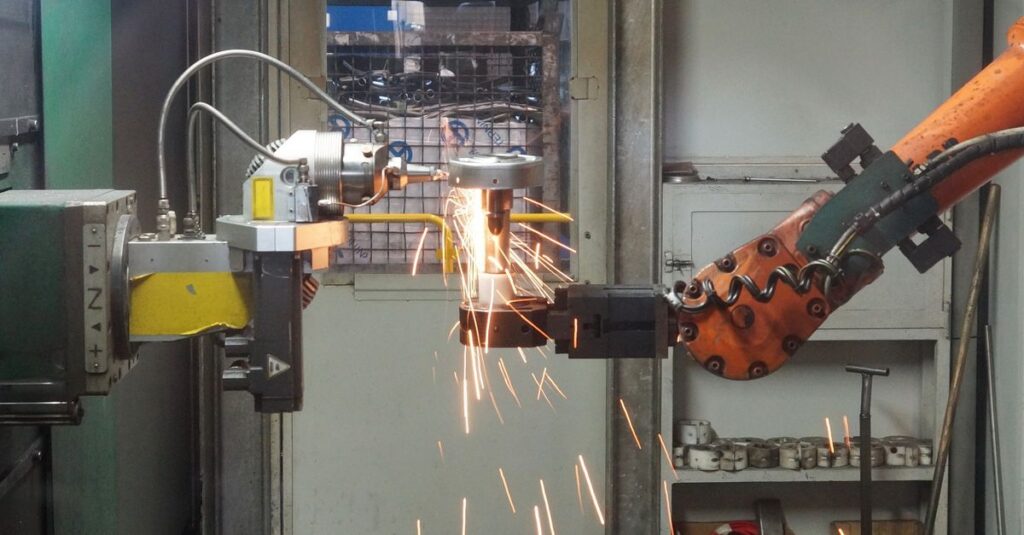
- Path Robotics AW-3 cell handles parts up to 70 feet long
- Company deploying Rove, a welding robot mounted on Boston Dynamics Spot quadruped
- System self-adjusts for each unique part without perfect tolerances
- Path raised $100 million Series D in 2024, bringing total funding to $271 million
Path Robotics’ autonomous welding system requires no programming and handles imperfect parts through proprietary scanning and computer vision technology that sees and understands nearly any part. The Columbus, Ohio company was founded in 2018 after co-founders Andy and Alex Lonsberry struggled with welding labor shortages in a failed custom vehicle business with their father. The industry faces a shortage of 400,000 welders by 2024, driving the robotic welding market toward $10 billion within five years.
Vision system eliminates teach-pendant programming
The system scans parts, self-adjusts for each unique piece, analyzes where a weld is needed, and generates all planning to execute a clean weld nearly instantly. Path designed the platform to operate precisely with highly reflective materials in manufacturing environments. The AF-1 cell picks, fits, and welds parts without human intervention.
This approach contrasts with traditional vision-guided welding, which still relies on taught paths. Teaching-playback and offline programming methods fail to meet high-precision requirements for complex intersection curves, and machining errors cause deviations from intended trajectories. Path’s system bypasses these limitations by generating paths on the fly from sensor data.
Rather than selling equipment, Path operates its own welding cells and charges customers for welding capacity, eliminating upfront equipment costs that deter mid-market fabricators from six- or seven-figure capital commitments. That business model requires managing fleet maintenance, logistics, and service-level guarantees across a distributed base—operational challenges fundamentally different from technology development.
Spot quadruped brings welding to shipyards
Path’s Rove robot mounts a torch on Boston Dynamics’ Spot quadruped with a hose connected to a fuel source, delivering mobility and balance suited to shipyards where welders bounce around sites and bend to make welds feet off the ground. Once in position, the robotic arm extends, a laser scans the welding site, and a torch ignites to close the seam.
Newport News Shipbuilding evaluated Spot for its spatial recognition and smart sensing, testing its ability to open water-tight doors and operate valves. The evaluation found Spot most valuable in unsafe environments and for repetitive tasks, with real-time data gathering as another advantage. Path’s Obsidian AI system, trained on the company’s own testing ground, allows welding robots to adapt and move with precision.
Labor shortages drive robotic welding adoption
Lead times on transformers jumped from 20 months to five years because skilled labor cannot keep pace with infrastructure bill demand, with 157,000 welders approaching retirement and 80% of welding still manual. Path deploys both welding cells autonomously across fabrication shops in the U.S. and Canada.
Incumbents Lincoln Electric, FANUC, ABB, and Miller/ITW hold deep customer relationships and service networks with capacity to bundle adaptive welding features into existing platforms, threatening Path’s narrow moat unless the startup establishes commercial traction before incumbents close the capability gap. Path’s advantage hinges on its proprietary perception stack and first-mover deployment at volume, but unit economics remain opaque. No public data on fleet utilization rates or unit economics is available.
Path’s real contribution is proving that computer vision can eliminate teach programming for welding—a capability that matters most where part variability is high and production volumes are low. Fabrication shops running mixed batches gain immediate value. But the Robotics-as-a-Service model transfers CapEx risk to Path, and success depends on asset utilization rates the company has not disclosed. Shops evaluating autonomous welding should compare Path’s subscription costs against the total cost of ownership for incumbent systems with newly added vision packages, which are arriving fast.
How does Path Robotics’ welding system differ from traditional robotic welding?
Path’s system requires no programming and needs no perfect parts, using proprietary scanning and computer vision to see and understand nearly any part with the ability to self-adjust for each unique piece. Traditional systems rely on teach-pendant programming or offline code generation and assume tight tolerances.
What is the Rove welding robot and where is it deployed?
Rove is a welding robot mounted on Boston Dynamics’ Spot quadruped being deployed in shipbuilding applications, delivering mobility and balance suited to environments where welders must move around sites and bend to reach weld locations. The system’s robotic arm extends, a laser scans the site, and a torch ignites to close the seam.
Article Source: How Path Robotics uses AI to optimize robotic welding