- Hadrian raises $1.37 billion at $7.87 billion valuation for automated defense factories
- Expanded to 3 million sq. ft. across four sites since Series C
- Pentagon pushes contractors for faster munitions production amid shortages
- Factories-as-a-service model targets munitions, shipbuilding, autonomous systems
Hadrian Automation closed a $1.37 billion Series D financing round that values the defense-focused manufacturing startup at $7.87 billion—a nearly 5x jump from its $1.6 billion valuation in January 2026. The company’s Factory 4 project in Cherokee, Alabama, combines more than $1.5 billion in private capital with $900 million in Navy funding to make components for Virginia-class and Columbia-class submarines. The timing coincides with a Pentagon memo ordering weapons manufacturers to present, within 21 days, plans for faster supply and expanded production capacity for weapons systems defined as critical, as development processes that take years no longer match the needs of the U.S. military.
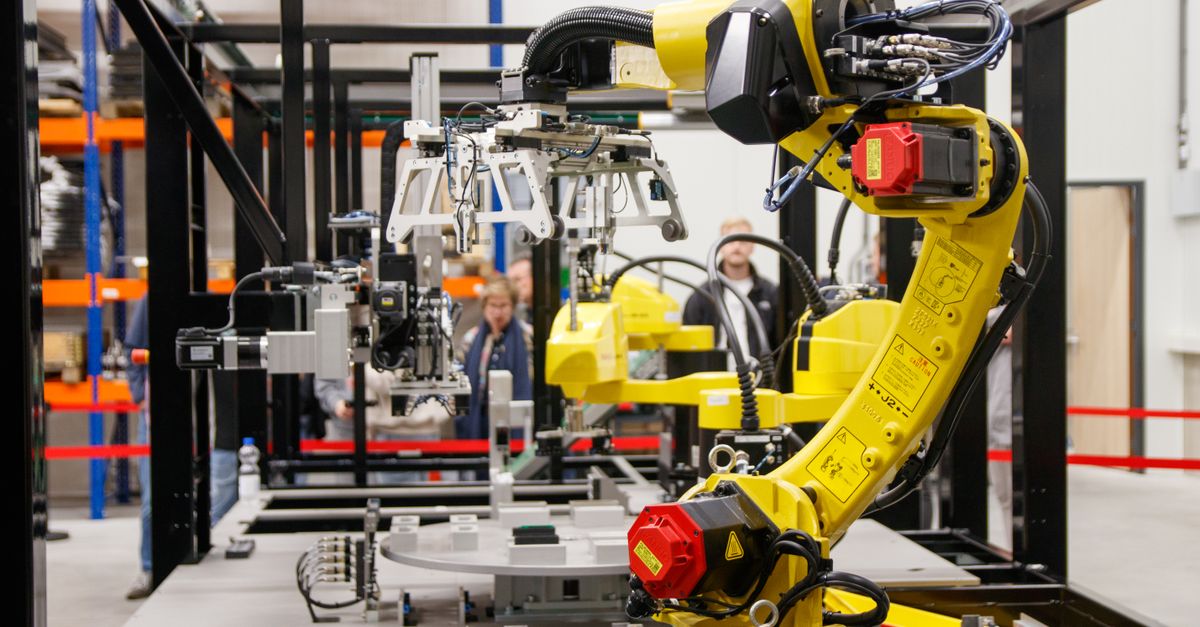
Founded in 2020 by Chris Power, Torrance, Calif.-based Hadrian operates highly automated factories using its proprietary Opus software stack for production autonomy. The company said it will use the capital to open additional factories and expand into munitions and autonomous systems production lines over the next year.
Munitions shortage opens market for rapid-build factories
Manufacturing lead times for critical weapons range from about two to more than four years, underscoring the difficulty in rapidly replenishing stockpiles during a major conflict. Domestic production capacity for black powder, an essential component in artillery shells, has shrunk to the point where it represents a critical bottleneck in ammunition manufacturing. Hadrian’s proprietary Opus software lets the company launch fully automated factories in under six months.
Following the Cold War, consolidation within the defence sector reduced the number of suppliers, while production lines for critical inputs, including solid rocket motors, explosives, shell bodies, rare-earth components, and microelectronics, were either scaled back or allowed to stagnate, with the emphasis on lean supply chains and cost efficiency creating multiple single-source bottlenecks. The result: the defense industry restructured itself for efficient production at peacetime rates, with surge capability regarded as unnecessary and wasteful, so very little spare capacity was available when the Department of Defense decided to surge some production in 2022.
The factories-as-a-service model Hadrian is scaling differs from traditional contract manufacturing. Rather than requiring defense primes to invest years and hundreds of millions in dedicated facilities, the approach delivers pre-built, automated capacity that customers can tap on shorter timelines. That elasticity matters when American war games have repeatedly demonstrated that a high-intensity conflict in the Indo-Pacific, particularly over Taiwan, would consume precision-guided munitions at a pace far exceeding current production capacity.
Expansion across four sites totals 3 million sq. ft.
Since its $260 million Series C round 12 months ago, Hadrian has opened new factories in Mesa, Ariz., and Muscle Shoals, Ala., bringing total capacity to just under 3 million sq. ft. across four sites. Hadrian celebrated the opening of Factory 3 (F3), a large-scale manufacturing and software hub in Mesa, Arizona, where Hadrian has invested $200 million in the 290,000-square-foot facility, which will bring over 350 new jobs to the community in early 2026.
The company also launched Hadrian Additive in January 2026, a dedicated division designed to deliver scalable, production-ready additive manufacturing capacity for the Defense Industrial Base. Hadrian initially focused on producing precision components but is expanding its platform to deliver more complete systems for defense and industrial customers.
JPMorgan, traditional defense investors back buildout
WCM Investment Management, Washington Harbour Partners, Valor Equity Partners, 137 Ventures, and Baillie Gifford co-led the Series D round. JPMorganChase’s Strategic Investment Group joined as an anchor co-lead through the firm’s Security and Resiliency Initiative, which invests in industries considered important to U.S. national and economic security. The round also included major financing from 1789 Capital, Morgan Stanley Wealth Management, funds managed by Apollo, and accounts advised by T. Rowe Price Associates, along with existing investors including CapitalG, Andreessen Horowitz, Founders Fund, and Lux Capital.
Hadrian stated it is creating a new workforce model for U.S. manufacturing, hiring and training operators, engineers, and technologists to work inside its factories where software, robotics, and human expertise combine on the factory floor.
Hadrian’s rapid capital raise and factory expansion reflect the Pentagon’s shift from just-in-time defense procurement to surge manufacturing capacity. The company’s ability to stand up automated facilities in six months—versus the multi-year timelines typical for defense production lines—positions it to capture contracts as the Department of Defense pushes for faster delivery schedules. Hadrian’s software-driven approach will be tested as it moves from precision parts into full munitions and autonomous systems assembly where tolerances and regulatory scrutiny intensify.
What is Hadrian’s Opus software platform?
Opus is Hadrian’s proprietary software stack for production autonomy that powers its highly automated factories. The system integrates process engineering, AI, machine learning, and robotics to manage scheduling, CNC machining, inspection, and other traditionally manual operations. Hadrian claims Opus enables it to launch fully automated factories in under six months, significantly faster than traditional defense manufacturing buildouts.
How does factories-as-a-service differ from contract manufacturing?
Traditional contract manufacturing requires customers to source and qualify suppliers, then wait for capacity allocation and tooling setup. Hadrian’s factories-as-a-service model offers pre-built, automated manufacturing capacity that defense primes and government customers can access without investing in dedicated facilities. This approach converts fixed capital expenditures into variable operating costs and allows faster scaling across programs like munitions, shipbuilding, and autonomous systems without the multi-year lead times of building new production lines.
Article Source: Hadrian raises $1.37B to accelerate U.S. defense, aerospace manufacturing