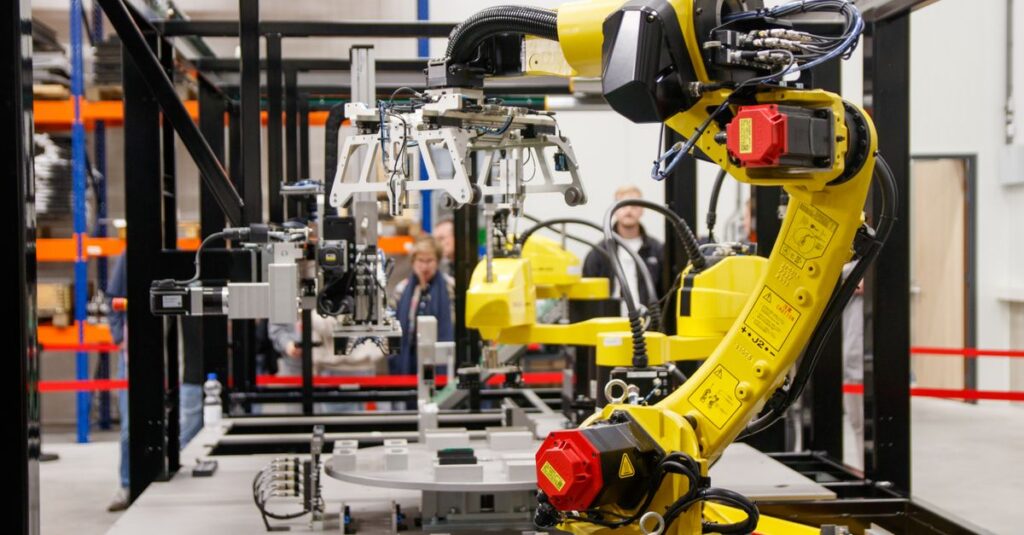
- Vision language models achieved 0.86 accuracy versus 0.77 for conventional facial analysis systems
- VLM training used videos of robot-human handovers with contextual emotion labeling
- 31 of 40 participants preferred emotionally adaptive robot apologies over scripted responses
- Trust declined after robot task failures regardless of apology quality or personalization
Researchers at the University of Melbourne have developed a method to train collaborative robots to recognize human emotions using vision language models (VLMs), a technology that analyzes both facial expressions and contextual behaviors during human-robot interactions. The system outperformed conventional facial analysis approaches, achieving a semantic similarity score of 0.86 compared to 0.77 for traditional AI methods. For plant managers deploying collaborative robots in manufacturing environments, this research reveals both the promise and limitations of emotional intelligence in improving workplace safety and collaboration efficiency.
The development aligns with Industry 5.0 principles emphasizing human-machine synergy in smart factory ecosystems, where cobots now represent 21% of assembly installations and demonstrate repeatability to ±0.02 mm in precision applications.
How Do Vision Language Models Improve Emotion Recognition?
Vision language models function similarly to large language models (LLMs) like ChatGPT but process visual inputs alongside text. The Melbourne team trained their VLM using volunteers who watched videos of robot-human object handovers and described emotional states while considering full interaction context rather than isolated facial expressions.
For example, a furrowed brow during task concentration differs from anger, with contextual cues like finger drumming or lip pursing revealing the actual emotional state. In manufacturing contexts, accurately predicting human emotions is essential for enhancing both efficiency and safety in human-robot collaboration. The VLM’s ability to process entire scenes—including worker position, activity, and robot interaction patterns—provides more reliable emotion assessment than facial analysis alone.
Maintaining consistent human safety and effective collaborative productivity requires precise and seamless communication between human operators and robots, making contextual emotion recognition particularly valuable for manufacturing applications.
What Did Testing Reveal About Trust and Robot Apologies?
In experiments with 40 volunteers, researchers deliberately programmed robots to make errors, then evaluated responses to two apology types: emotionally adaptive apologies based on perceived human reactions versus pre-scripted verbal apologies. While 31 participants preferred the personalized emotional response, the results exposed a critical limitation for industrial applications.
Regardless of apology quality, participants consistently rated their trust in the robot lower after it failed its task. This finding carries significant implications for manufacturing operations where trust is essential for enhancing collaboration and maintaining safety, as under-trusting robots hinders productivity while over-trusting leads to accidents. The research suggests that while emotional adaptivity acts as “social lubricant,” it cannot compensate for functional failures.
Current collaborative robots in manufacturing were designed to be productivity-centered, often overlooking human emotions as important factors that could potentially impact the collaboration process. These cobots still lack recognition of human emotional states despite advances in physical safety features.
What Are the Manufacturing Implications?
The research, published in IEEE Robotics and Automation Letters in May 2025, arrives as cobot shipments reached 73,000 units globally in 2025, with the market projected to grow from $1.2 billion in 2023 to $29.8 billion by 2035. Human-robot collaboration capitalizes on complementary abilities of human cognition and fine-motor skills combined with robotic repeatability, strength, and speed, with cobots playing critical roles in agile manufacturing to foster competitiveness and resilience.
For engineers implementing advanced robotics systems, the Melbourne study highlights that emotional recognition technology must work alongside—not replace—fundamental reliability and performance metrics. In manufacturing settings, preprogrammed cobot movements may not align with human collaborator expectations or leave workers uncomfortable, deterring future collaboration. Vision language models offer potential solutions by enabling robots to detect discomfort or confusion before safety issues arise.
However, achieving genuine human-robot interaction faces challenges including real-time robot behavior adaptation based on worker emotions revealed through facial or body signals, with practical implementation hiding complexities despite extensive exploration in human-machine interaction fields. Manufacturing facilities must balance investment in emotional intelligence capabilities against core automation performance requirements and measurable productivity gains.
Vision language models represent a significant advance in robot emotion recognition, but plant managers should view them as complementary to—not substitutes for—reliable task execution. While emotionally adaptive robots may improve worker comfort and communication during collaborative tasks, functional performance remains the primary driver of trust and productivity in manufacturing environments. The technology shows particular promise for safety-critical applications where detecting worker stress or confusion could prevent incidents, but requires integration with robust quality control and performance monitoring systems.
Frequently Asked Questions
Q: How does contextual emotion recognition improve safety in collaborative robot applications?
Vision language models analyze full interaction contexts including body language, positioning, and task behaviors rather than isolated facial expressions, enabling robots to detect worker stress, confusion, or discomfort before these states escalate into safety incidents. This provides earlier warning signals than conventional facial analysis systems, though reliability depends on proper system training for specific manufacturing environments and tasks.
Q: What ROI considerations should manufacturers evaluate before implementing emotion-recognition cobots?
Standard collaborative robots achieve ROI within 8-14 months with 35-50% lower deployment costs than traditional industrial robots. Emotion recognition capabilities add system complexity and may extend integration timelines, so manufacturers should prioritize applications where detecting human emotional states directly impacts safety metrics, quality outcomes, or worker retention in high-turnover operations rather than treating it as a universal requirement for all cobot deployments.
Article Source: Visual Language Models Train Robots to Read Human Emotions